
Be gentle. Those are my legs! Airline Travel As a Wheelchair Using Quadriplegic

Airline Travel As a Wheelchair Using Quadriplegic

UPDATE FROM DIAMOND PASSENGER LIFT CO.

Training was provided @MCO on several different dates in 2017 and 2018… Training was free and was offered to any airline or service provider who wished to attend.. The purpose of the free training was to make sure their were trained personnel to utilize the Eagle lift that was purchased by MCO…

Recently, I traveled through Orlando’s International Airport to Minneapolis-St. Paul where I attended a portion of the Paralyzed Veterans of America National Convention. As a C3 complete quadriplegic, traveling often takes its toll.  Due to the limited training of staff and airlines reluctance to understand my type of disability; I am disinclined to travel by airline. Having only traveled by airline once before (now 6: 2019) as a wheelchair using quadriplegic.

…the Orlando airport has ultimately worsened in respect to my needs.

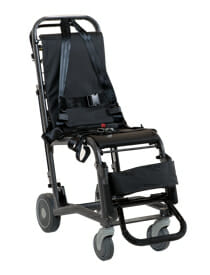
At that time (2016), the Orlando airport utilized a lift system that properly on-boarded me to my seat. The issue then was that the gate agents and airport employees did not realize that the lift system existed, but were able to finally locate it with the paramedic services and
Airline Travel As a Wheelchair Using Quadriplegic

EMS.

Fast-forward to May 2018 and apparently, the Orlando airport has ultimately worsened in respect to my needs.

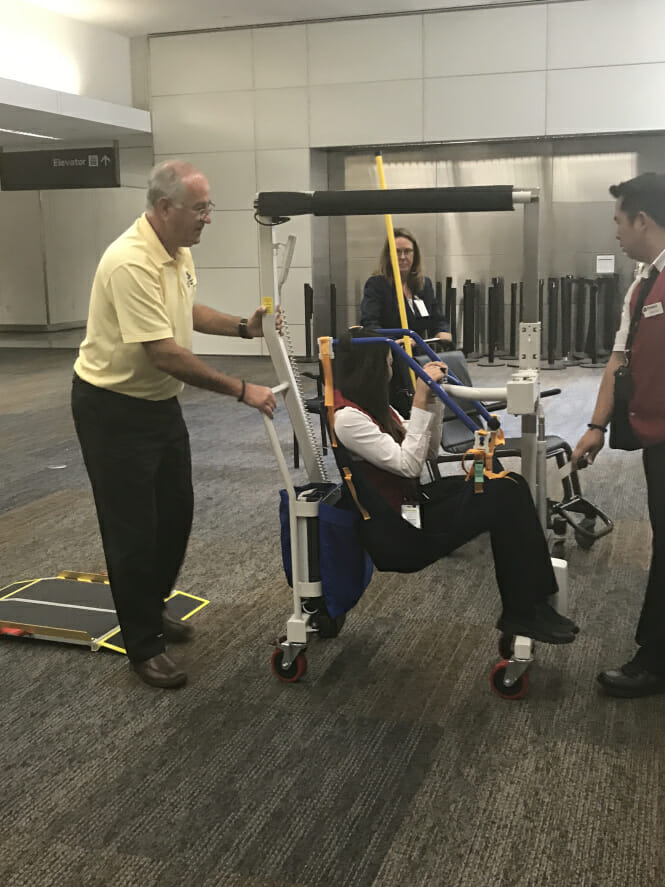
According to the gate agent at the Delta terminal, they could no longer use the lift system due to the “training cost” associated with ensuring their employees were properly certified on the equipment.  I used the device two years before but was told not all terminals or airlines have paid for the training.

…at the Delta terminal, they could no longer use the lift system due to the “training cost”

Airline Travel As a Wheelchair Using Quadriplegic

The general manager of Prospect Airport Services explained that Delta’s reasoning was accurate, and they could not even occupy the terminal because of insurance liability. I communicated to the gate agent the liability of manually lifting me and transferring me, is greater than if they were to use the lift.  They quickly redirected back to the training cost. Why aren’t the airlines paying to train their employees?  They need to know proper techniques to safely transfer customers with disabilities.
 Airline Travel As a Wheelchair Using Quadriplegic
Utilizing the Eagle Lift for Airline Traveler with Limited Mobility

This is why airline travel as a wheelchair using quadriplegic and other people with disabilities is difficult. Further reducing our ability to live a normal life.

Why aren’t the airlines paying to train their employees?

Transferring with inappropriate equipment poses risks to the physical and emotional health of people with disabilities.  According to Prospect Airport Services, the training cost $4000 per employee (it’s actually free).

Airlines Will Not Pay for the Training

Given that one of my tickets was $700; I assume the airlines could afford to provide passengers with dignity, respect, and safe mode of transfer. This is not the case at either the Orlando airport, that had the equipment, or the Minnesota St. Paul airport which did not have the equipment.

I made it through my travel with only minor bruises and a small device broken from my wheelchair. I believe that airline employees should have a better understanding to be gentle with this equipment. Ask anyone with paralysis if they do not have their wheelchair it is the same as someone taking their legs away from them.

Get Ready for More Wheelchair Users

Orlando is home of the 2018 38th annual National Veterans Wheelchair Games with several hundred wheelchair users flying into the Orlando airport. Accommodations will have to be made for these athletes at every gate and in every terminal. Great work has been done with the air access laws, Continuing efforts through air access laws is necessary to eliminate these issues.

Thank you
Airline Travel As a Wheelchair Using Quadriplegic

Make Your Insurance Pay for a Standing Power Wheelchair

Make Your Insurance Pay for a Standing Power Wheelchair

Please Feel Free to Use the below Email As a Template

For most wheelchair-bound individuals walking or standing can be not only of great physical therapy but also mental therapy as well. However, there are barriers for the average person in a power wheelchair and manual wheelchairs restricting their ability to obtain a wheelchair that will assist them in standing. Make Your Insurance Pay for a Standing Power Wheelchair.

I received my first power wheelchair while an inpatient rehab at the James Haley VA spinal cord injury center which was a Permobil C400. As a letter below will describe several issues arise from sitting all day and not being able to stand. Given my level of activity even as a C3 complete quadriplegic my medical condition necessitates standing to relieve some of the symptoms and chronic issues I was having.

How to Make Your Insurance Pay for a Standing Power Wheelchair

I’ve tried to list the steps below based on my experience. However, because I use the VA your experience may differ through Medicaid-Medicare-Private Insurance but what remains the same is identifying issues you have from not being able to stand and then obtaining documentation from your doctor advising it is medically necessary for you to stand more often and independently throughout the day.

What made a great difference for us was the difficulty of using a standing frame. Typically, the first thing insurance will recommend is a standing frame. But, to reap the benefits of standing you must be able to do it often. My issue with the standing frame is that it took two individuals and about an hour to get me into it with the Hoyer lift.

How to Make Your Insurance Pay for a Standing Power Wheelchair

Step One.

Realize You Need a Standing Wheelchair.

Do you have bowel and bladder issues? Circulatory issues? Social issues?

Step Two.

Identify Chronic Issues You Have That Standing Would Decrease.

Frequent UTI?

Inconsistent  Bowel Program?

Blood Clots?

Step Three.

Put This Information in Writing and Submit to Your Primary Care Doctor.

Here is a great resource for finding solutions to some of your chronic medical issues through the use of the power standing wheelchair.

http://www.rstce.pitt.edu/rstce_resources/rstce_res_doc/resna_position_on_wheelchair_standers.pdf

Step Four.

Follow-Up (Most Important Step)

Contact the doctor once you’ve sent the information to ensure they receive it and then follow up on a weekly interval to find out where they are at in the process. You may be able to contact your durable medical equipment (DME) provider or your insurance provider as they may give you specific instructions regarding your particular chair.

Step Five.

Be patient

Rome wasn’t built in a day. It takes time and some persistence to obtain expensive medical equipment especially when dealing with government agencies and especially civilian doctors and insurance. Feel free to comment in the section below and I’ll do my best to assist you in any way possible.

My letter to the doctor:

Dr. name omitted,


(Name omitted) I am writing to you in regards to a request for a standing wheelchair to replace my current power chair due to medical necessity. It’s come to my attention that I would need to provide proof of medical necessity to the KT department in order to obtain a standing wheelchair. Specifically the F5-VS from Permobil which is the model the VA typically issues. I have put a link below to the Rehabilitation Engineering & Assistive Technology Society of North America (RESNA) position on wheelchair standing devices as well for your review. Although it’s obvious you understand the benefits of standing because of seeing your desk 🙂


In regards to my specific case the following applies over the past year:

  • history of UTI (two of which led to a hospitalization)
    • standing allows for proper and more complete voiding of the bladder
    • “Urinary Tract Infections Urinary Tract Infections (UTI) is the third most frequent complication for clients with SCI  , and a frequent secondary complication for many other wheelchair users. Prolonged immobility causes hypercalcemia, increased urinary calcium output  , and also reduces bladder emptying . By reducing contributing risks, standing wheelchairs have been shown to reduce the occurrence of UTI for wheelchair users , which could lead to kidney infections”
  • history of bowel obstruction (one incident lead to hospitalization)
    • “Bowel function. Some users have experienced improved bower regularity, reduced constipation, and lesser occurrence of accidental and unregulated bowel movement as a consequence of using wheelchair standers . Elimination of chronic constipation and significant reduction in bowel care time has also been shown as a result of frequent standing  . Chronic constipation can lead to bowel obstruction, a dangerous condition often requiring surgery. Unregulated bowel movements can lead to fecal incontinence at a time when the client cannot be cleaned by a caregiver, increasing the risk of developing pressure sores.”
  • circulatory issues chronic swelling in feet and legs (history of clots)
    • “Users have also experienced improvement in lower extremity circulation as a consequence of utilizing a wheelchair stander . Some benefits are reduced swelling in the legs and feet.”
  • history of blood clots resulting from poor circulation
  • history of pressure sore
    • “Pressure sores When fully standing, pressure is 100% relieved off the Ishial Tuberosities (ITs). However, when tilting or reclining, there is only partial redistribution of pressure underneath the ITs. Pressure ulcers are the primary complication for people with SCI , and many other adults who sit in wheelchairs all day long. There is evidence that users have suffered fewer pressure sores while using standers  , or integrated wheelchair standers .”


Having the ability to independently stand intermittently throughout the day would vastly improve/reduce the issues above as stated by RESNA in the accompanying link. It is RESNA’s position that wheelchair standing devices are medically beneficial for wheelchair users by: enabling them to reach; improving ADL abilities; enhancing independence and productivity; maintaining vital organ capacity, bone mineral density, circulation and range of motion; reducing tone and spasticity, the occurrence of pressure sores and skeletal deformities; and enhancing psycho-social well-being.


I have proven the ability to tolerate standing as I have used the standing frame however due to the nature of that equipment and my active lifestyle I’m not able to use it in a capacity that would be as helpful as a standing wheelchair. Also it requires at least two caregivers or helpers to assist me while the wheelchair allows me to be independent.


The above represents a small portion of all the benefits from regularly being able to place myself in a standing position. Thank you for your consideration and your time I look forward to speaking with you regarding this issue.


http://www.rstce.pitt.edu/rstce_resources/rstce_res_doc/resna_position_on_wheelchair_standers.pdf

Make Your Insurance Pay for a Standing Power Wheelchair


Thank you

Charlie Merritt

C4 Quadriplegic

Check out My Blog quadcapable.com

Facebook.com/quadcapable

Tweet me @quadcapable