
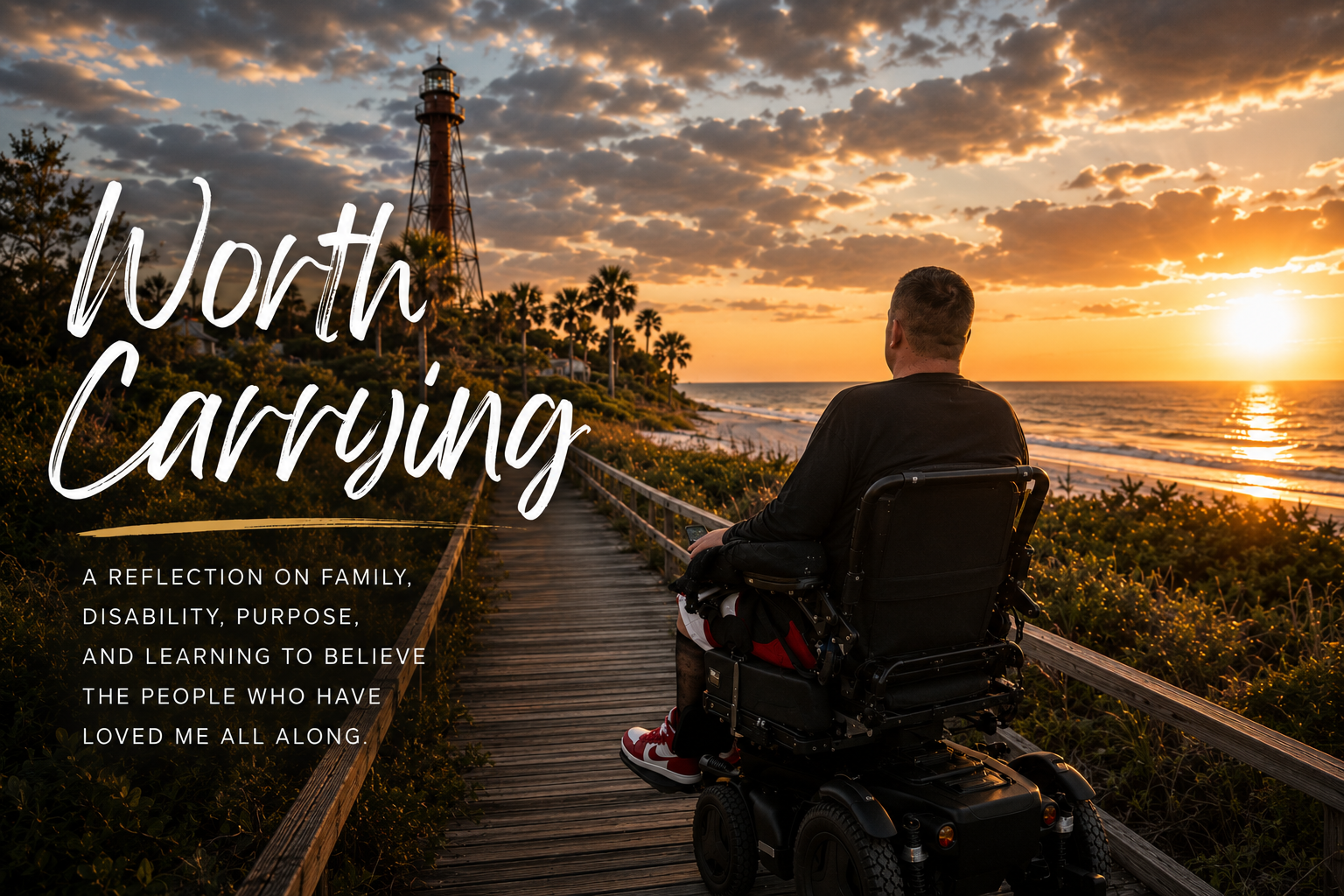
Some of the strongest people you’ll ever meet are the ones who taught others they were worth carrying.
RESILIENCE • FOUNDATIONS
By Charlie Merritt • July 2026 • 6 min read
I’ve spent a lot of time over the past twelve years thinking about what it means to be a burden.
It’s not a conversation people like to have, especially in the disability community. Most of us have heard the same reassuring words from the people who love us: “You’re not a burden.” My parents have told me that. My caregivers have told me that. My friends have told me that. And every one of them meant it.
The truth is, I’m not sure I’ve ever fully believed them.
Before I broke my neck, one of the ways I showed love was by providing. I built a business. I planned adventures. I bought a boat because I wanted my family to spend weekends making memories together. I worked hard because I wanted the people I loved to have opportunities and experiences maybe they wouldn’t have had otherwise. Looking back, I didn’t even realize I was living my dream until I was already living it.
Then, in an instant, everything changed.
When I woke up in the hospital, my first thought wasn’t, “Will I ever walk again?” It was, “How am I going to take care of the people I love?” That question has followed me ever since.
My parents drove through the night to be with me. My dad stood beside my hospital bed, pointed at my tracheostomy, and said, “We’re going to get that out.” Then he pointed at my hands and said, “We’re going to figure those out next.”
My mom had a different approach. She knew exactly which buttons to push because she’d been pushing them since I was a little kid. She wasn’t about to let me quit on myself. If she had to tease me, challenge me, or remind me who I was before the injury, she did. It wasn’t because she was hard on me. It was because she knew her son.
Neither of them treated me like my life was over. They simply started helping me solve the next problem.
Even with all of that love, I quietly carried another thought:
Am I worth all of this?
It’s a question I still wrestle with.
I still catch myself measuring my worth by what I accomplish. If I have a productive day—if I help a veteran, move a business forward, write something meaningful, solve a problem, or encourage someone who’s struggling—I feel like I’ve earned my place. On the days when I can’t do those things, I sometimes feel like I’ve let everyone down.
Maybe that’s something a lot of people living with disability never say out loud.
Maybe caregivers wonder if they’re doing enough.
Maybe parents quietly question whether they’re helping in the right ways.
Maybe all of us, in one way or another, spend more time trying to prove our worth than simply accepting that we’re loved.
Over the years, I’ve realized something I couldn’t see in those early days after my injury. My family wasn’t just carrying me physically. They were carrying fear, uncertainty, grief, and hope all at the same time. I don’t think I truly understood how heavy that was for them until years later.
That realization didn’t make me feel more like a burden.
It made me appreciate the kind of love that stays.
The people who carried me through my darkest days never convinced me I wasn’t a burden.
They convinced me I was worth carrying.
I’m not sure I’ll ever completely stop trying to prove my worth. Maybe that’s just part of who I am. But I’m beginning to wonder if the next step isn’t proving that I’m worth carrying.
Maybe it’s finally learning to believe the people who have been telling me that all along.
Charlie-ism
“Being carried never made me a burden. It reminded me I was worth carrying.”
Charlie’s Challenge
Before today is over, take a moment to thank someone who has helped carry you through a difficult season of life.
Maybe it was a family member, a friend, a caregiver, a therapist, a coworker, or someone who simply refused to give up on you when things were hard.
Then ask yourself one question:
Who am I helping carry today?
Strength isn’t measured by never needing help. It’s measured by what we choose to do with the help we’ve been given.
Because every one of us has been carried at some point in life—and every one of us has the opportunity to help carry someone else.
So Easy a Quadriplegic Can Do It™
One of the biggest lessons I’ve learned is that accepting help doesn’t make you less independent. It makes you more effective.
I rely on caregivers, assistive technology, voice control, and careful planning every single day—not because I’ve given up my independence, but because those tools give me more choices. They allow me to travel, work, advocate, and build a life that would otherwise be out of reach.
If there’s one idea I hope people take away from QuadCapable, it’s this: independence isn’t measured by how much you do alone. It’s measured by how fully you’re able to live your life.
If a system makes life easier, safer, or more accessible, use it. There’s no prize for making life harder than it already is.